How to get it
Explore these tips on how to request your health record — it’s your right.

Explore these tips on how to request your health record — it’s your right.
In this section:
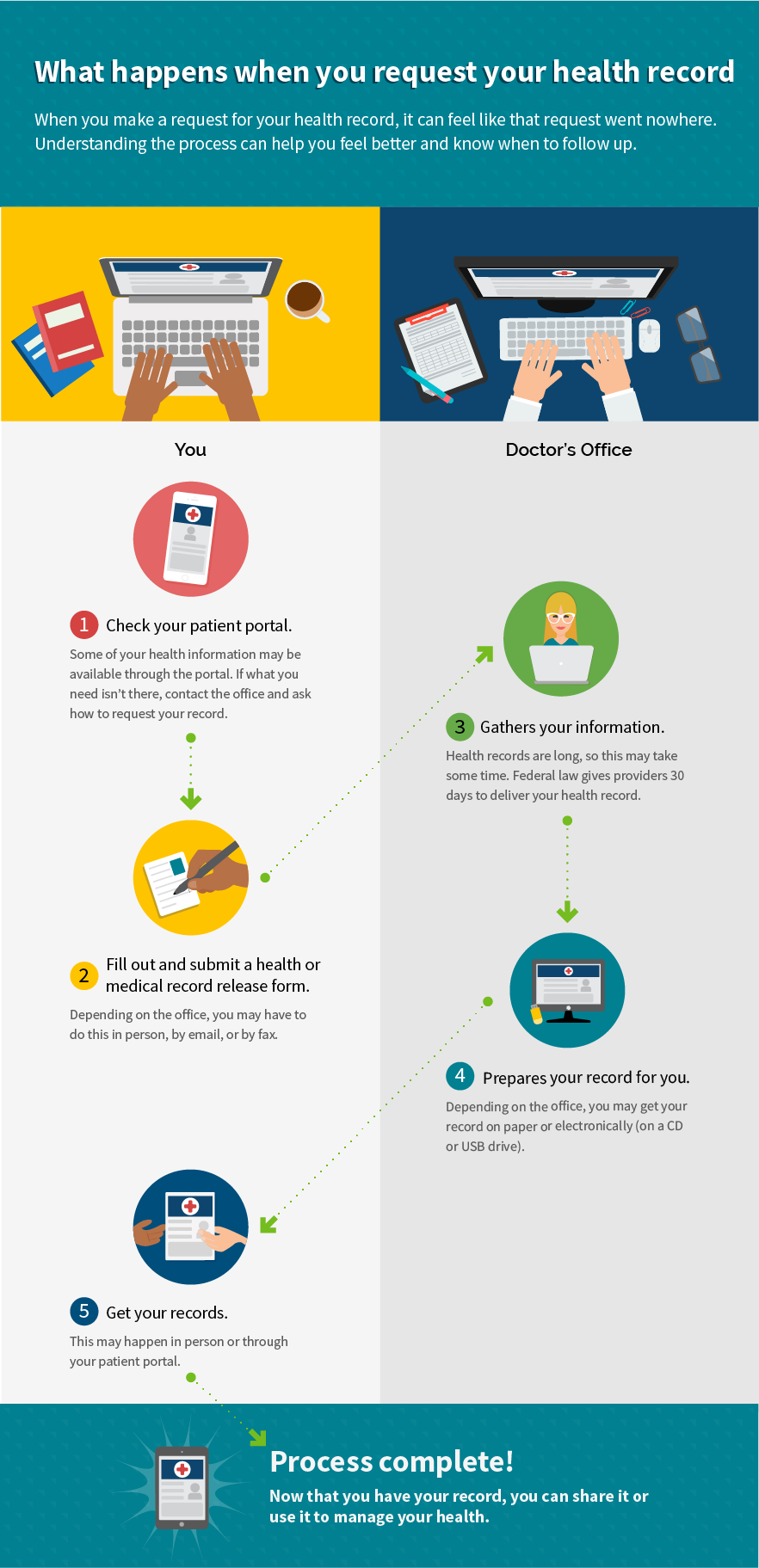
If you want to get your health record, it helps to understand how the process works. That way, you’ll know what to do if you hit a roadblock.
This guide won’t provide you with your health record but instead will teach you how to request it from your health care provider.
The first step is to check your health care provider’s online patient portal. A patient portal is a secure website where patients can often do things like make appointments, contact their provider, and look at lab results. Some of your health information, like a list of the immunizations you’ve had, may also be available through the patient portal.
Have you tried your provider’s online patient portal?
About 8 in 10 individuals who used their online patient portal found it helpful and easy to understand.
Source: ONC Data Brief 40 [PDF - 1.7 MB]
If the health information you need is not available through the patient portal, try other ways to contact your provider:

You can see and download some of your health information just by clicking on the Blue Button icon on your provider’s online patient portal. Look for the Blue Button icon on:

Frequently Asked Question
Yes, and the process is basically the same as getting your own record. If you have a medical power of attorney — legal paperwork allowing you to make medical decisions for the person — you have the right to access their record. Under HIPAA, a person who can legally make medical decisions for someone else is called a personal representative. If you’re not a personal representative, the person you care for can ask their health care provider to give you access to their health record. Get more information on personal representatives.

Troubleshooting Tip
If your health care provider says they can’t provide access to your health record because of HIPAA, tell them that both HIPAA and the Department of Health and Human Services (HHS) require them to give you access to your record. This is your protected right under the law. Learn more about HIPAA and how it protects your right to see and get your health information.
How you make your request will depend on your health care provider’s processes. You may be able to request your record through your provider’s patient portal. You may have to fill out a form — called a health or medical record release form — send an email, or mail or fax a letter.
Your provider’s medical request release form may be organized differently — there is not a standard form — but these are the questions you’re likely to see.
Whose health records do you want? Print their full name, date of birth, patient identification number (PIN), or medical record number (MRN). (PINs and MRNs are assigned by providers. If you don’t know your number, you can ask your provider.) You can request the health records for only 1 person per form.
Who has the information you want? This can be the name of any person who has cared for you or the place where you got care. Include the full name, address, phone number, and secure fax or secure email address.
When did you receive this care? This can be 1 day or a range of dates or years. If you’re not sure, ask the provider you received care from what dates you need.
What information do you need? This is to guide your provider in pulling the records you need. Often, it will be a set of check boxes. Check all that apply. [For more information, see What am I asking for?]
Where do you want to send the information? Enter the complete name of the person, place, or company, along with their address, telephone number, and fax number or secure email (through their patient portal). Note: If you need to send your records to more than 1 person, including yourself, a separate request may be required. Ask your provider what they need.
Why do you need this information? Often, the form will offer a set of check boxes, like ongoing care or new doctor. You can check all that apply, but according to HIPAA, you don’t have to provide this information in order to get your health record. So you can leave this section blank.
How long do you want this permission to share your records to be valid? Not all forms will include this section. However, if you don’t specify a date, most permissions will end 6 months to 1 year from the date you filled out the form. Note: According to HIPAA, you don’t have to provide this information in order to get your health record, and you can leave this section blank.
How and when do you want to have this information? This tells your provider if you’d like your records by a certain date and what kind of record you want — like paper or a PDF. Although you may ask to get your health records sooner, your provider can take up to 30 days to deliver your health record. [For more information, see What format do I need? and How do I want to get it?]
You must sign the form, or your provider will not be able to process your request.
Enter the date for the day you sign the authorization form.
If you’re not the patient, how are you related to the patient? If you’re getting the records of another adult, this is where you’ll tell the provider that you’re the other adult’s personal representative.
If you’re requesting health records for someone other than your child, you may be required to provide a copy of the legal paperwork giving you the right to access their health information — if their health care provider does not already have it.
Troubleshooting Tip
If you deliver your request form or letter in person, you’ll be asked to present your ID — like a driver’s license.
Frequently Asked Question
No. According to federal law, your provider must give you access to your health record, even if you have an unpaid bill.
You may have to pay a fee. However, according to your federal rights, your health care provider may only charge a reasonable fee for:
When you send in the request for your health record, ask your provider how much it will cost to get your record.
Troubleshooting Tip
In order to get your health record, you’ll need the full names, physical addresses, phone numbers, and fax numbers or secure emails (through their patient portal) of all the doctors and providers who are sending and receiving your health record.
According to federal law, your health care provider can take up to 30 days to deliver your health record. However, if you requested a specific delivery date, you may get your record sooner. If your provider needs more than 30 days, they must give you a reason for the delay and a new delivery date. They can take up to 30 extra days.
Frequently Asked Question
There are a few reasons why getting your record can take some time:
Troubleshooting Tip
After you send in your record request, it’s a good idea to check with your health care provider and make sure they got your request. Sometimes record requests get lost.
If you requested a specific delivery date and your record hasn’t come, or it’s been more than 30 days, call again. And if you feel that you’re not being taken care of, try calling these departments at your provider’s office: